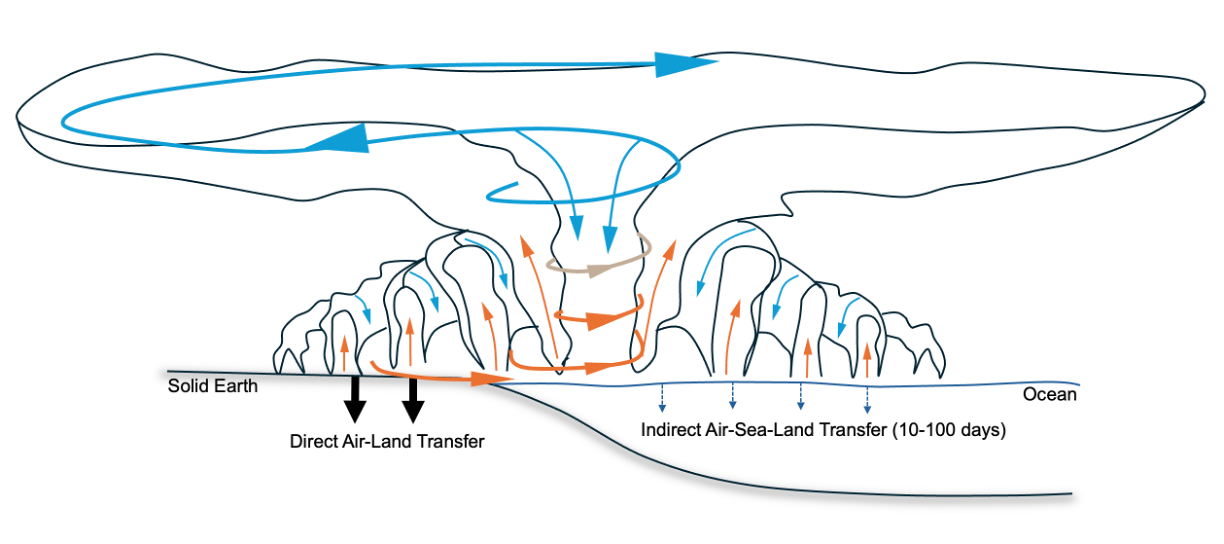
This project explores how landfalling tropical cyclones affect Earth’s rotation. We show that as a cyclone moves across land, surface friction enables a direct exchange of angular momentum with the solid Earth, leading to short-term day-to-day rotational variations. Notably, the magnitude of this effect is comparable to that associated with major earthquakes.
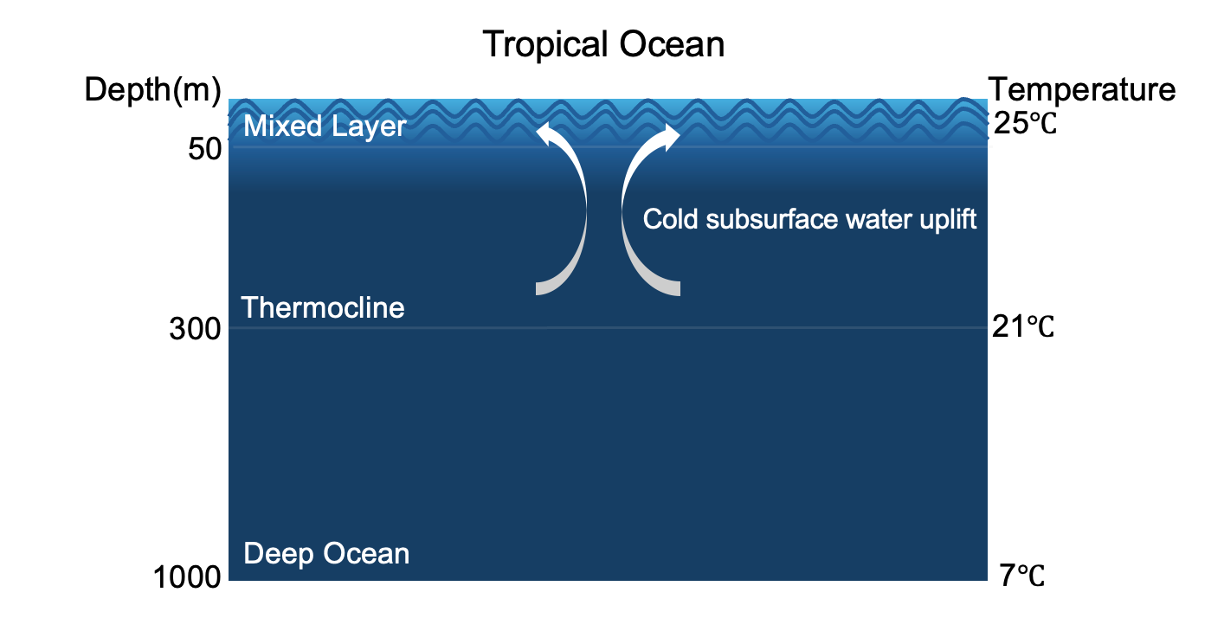
This is a highly ambitious and challenging project. We aim to leverage cutting-edge techniques, such as reinforcement learning, to pursue our goal: exploring how to weaken typhoon intensity at the lowest possible cost by reducing sea surface temperature (SST) through mixing colder subsurface water with warmer surface water.
Tropical cyclones are intense convective systems that concentrate atmospheric angular momentum. While it is theoretically known that the atmosphere exerts torque on the solid Earth, the storm-resolved, event-scale mechanical imprint from individual cyclones has remained poorly understood. Here we diagnose the atmospheric torque to show that a single intense tropical cyclone can jolt the Earth’s rotation, inducing Length-of-Day perturbations on the order of microseconds. Strikingly, this magnitude is comparable to the rotational variations caused by major earthquakes (Mw≥7), challenging the intuition that weather events are mechanically negligible compared to tectonic shifts. By coupling reanalysis data with idealized numerical simulations, we further reveal that while the storm’s intensity controls the amplitude of this response, its trajectory—specifically the direction of landfall (e.g. poleward versus equatorward)—determines the sign, yielding either a net spin-up or spin-down of the solid Earth. Our findings unveil a rapid, event-driven coupling between extreme weather and planetary rotation, with direct implications for high-temporal-resolution geodetic monitoring.